A witness usually already holds the answer you need. Whether you ever hear it depends almost entirely on how you ask. That is the uncomfortable, freeing lesson of half a century of interviewing research: the biggest variable in an interview is not the witness's honesty or memory, it is the quality of the questions put to them. Change the questions and you change the account.
This is the companion to our guide on spotting lies, which argued that you should stop reading faces and start listening to words. This piece is the how: the mechanics of asking. Three moves do most of the work, and they happen to be the exact loop of an interrogation game. Open the account up. Follow up without contaminating it. Then compare accounts so contradictions surface on their own.
This is a research guide for interviews, games, writing, and critical thinking, not legal or police-interrogation advice.
Key takeaways
The whole craft fits in five moves: open, clarify, follow the edge, compare, flag. Want to put it into practice? Third Suspect turns that loop into short witness-interrogation cases, where the right questions are the difference between naming the killer and accusing the wrong suspect.
1. The interview is the instrument
In a lab, you can measure a witness's memory directly. In a real conversation you cannot. You only ever see what your questions let out. So the interview itself is the measuring instrument, and like any instrument it can be precise or it can distort. Modern investigative-interviewing frameworks were built on exactly this realisation. The widely adopted PEACE model (Plan and prepare, Engage and explain, Account, Closure, Evaluate) is, at heart, a discipline for not contaminating the thing you are trying to measure [10]. It replaced older, confession-seeking interrogation styles precisely because those styles produced confident accounts that were too often wrong.
The shift in mindset is from extracting to eliciting. You are not prying a fixed fact out of a reluctant container. You are creating the conditions under which an accurate account can be reconstructed and spoken aloud. Get those conditions right and an ordinary witness will tell you far more, and far more reliably, than you expected. Get them wrong, with pressure, interruptions, and leading questions, and you will get a fluent account that quietly conforms to your own theory. The rest of this guide is the set of conditions worth getting right.
2. Open the funnel
The single biggest lever is the kind of question you ask. Questions fall on a spectrum from open ("Tell me what happened") to closed ("Was he wearing a hat?"). Across decades of studies and every major interviewing protocol, the finding is consistent: open-ended questions elicit the most detailed and the most accurate accounts, while specific and closed questions raise the risk of error in what comes back [6][1]. Fisher and Geiselman put it plainly: answers to open questions ("Describe his appearance") are more accurate than answers to closed ones ("Did he have a beard?") [1].
The reason is mechanical. A closed question hands the witness a narrow slot and asks them to fill it, often forcing a guess where they should have said "I don't know." An open question hands them the floor and lets the memory run, in their own order, at their own grain. So the first rule of questioning is counter-intuitive for most people, who instinctively fire specific questions: open first, narrow later. Start every topic with free recall, a wide invitation, and only move to specifics once the witness has spilled everything they can volunteer.
A simple habit makes this automatic: lead with TED prompts. Tell me about the evening. Explain what happened at the bar. Describe the man who left first. Each is an open door rather than a keyhole.
3. Don't lead the witness
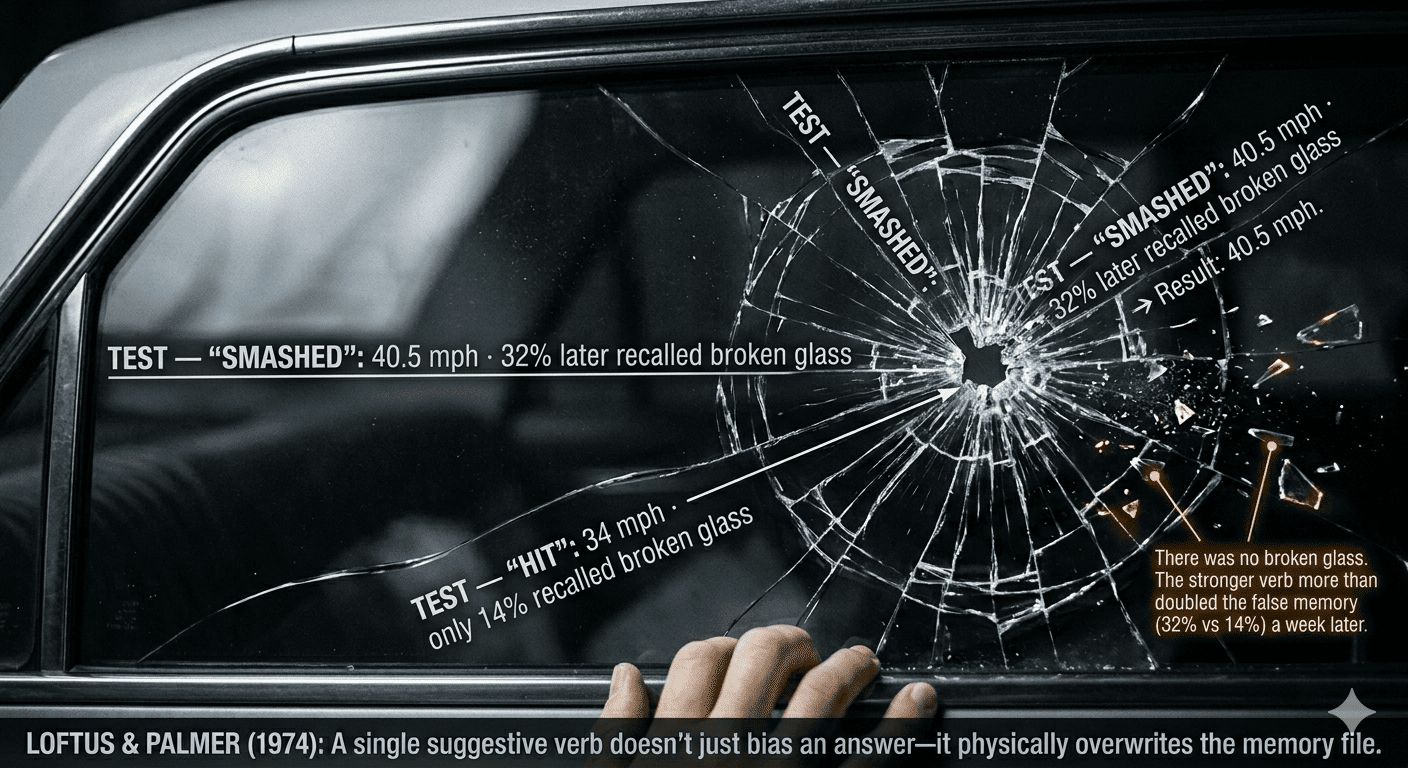
If open questions are the most powerful tool, leading questions are the most dangerous. They do not just fail to retrieve a memory, they rewrite it. The classic demonstration is Loftus and Palmer's 1974 study. Participants watched the same car-crash film, then were asked how fast the cars were going. The only thing that changed between groups was a single verb. Asked how fast the cars were going when they "smashed" into each other, people estimated 40.5 mph. Swap "smashed" for "collided" and the estimate dropped to 39.3, then "bumped" 38.1, "hit" 34.0, and "contacted" just 31.8 mph [2]. One word moved the remembered speed by roughly nine miles an hour.
It gets worse. A week later, the same witnesses were asked whether they had seen any broken glass. There was none in the film. Among those originally questioned with "smashed," 32% said yes, more than double the 14% in the "hit" group [2]. The leading word had not merely biased an answer in the moment. It had seeded a false detail that grew into a memory. This is the misinformation effect, and it is why suggestive and forced-choice questions are treated as contamination, not technique. The same dynamic, scaled up under pressure, is part of how coercive interviews produce false confessions [9].
The practical rule is strict: never feed the answer into the question. Not "He was angry, wasn't he?" but "How would you describe his mood?" Not "Was the car red or blue?" but "What colour was the car?" Assume that any detail you supply may come back to you wearing the costume of the witness's own memory.
4. The Cognitive Interview
If "open first, don't lead" is the foundation, the Cognitive Interview (CI) is the fully built house. Developed by Ronald Fisher and Edward Geiselman, it is a structured set of techniques for helping a cooperative witness retrieve more without sacrificing accuracy. Its results are among the most robust in applied psychology. Across studies, the CI elicits roughly 25 to 40 percent more correct information than a standard interview. In one meta-analysis of 55 experiments, 53 found the CI produced more information, with a median increase of 34%, and accuracy held steady or improved (around 85% correct in the CI versus 82% in the control) [1][3]. You get substantially more, and it is not junk.
A few of its moves are easy to borrow:
- Build rapport first. A witness who feels safe and unhurried reports more. Most interviews fail before they begin by rushing this.
- Report everything. Explicitly invite the witness to include details that seem trivial or partial. The "irrelevant" fragment is often the lead.
- Reinstate the context. Ask them to mentally rebuild the scene before recalling events: the sounds, the weather, where they were standing, and, crucially, their internal state, what they were feeling and thinking in the seconds before it happened. This is not mysticism. It is the encoding-specificity principle: a memory is easiest to retrieve when the conditions at recall match the conditions when it was stored, and the emotional state at the moment of encoding acts as a tether that drags the sensory details back with it [1][11].
- Vary the retrieval. Try recalling in a different order, or from another vantage point. Different routes reach details a single linear pass misses.
- Let the witness do the talking. The interviewer's job is to ask less and listen more, shaping the witness's own narrative rather than overwriting it.
Notice what is absent: tricks, pressure, and clever closed questions. The CI works by getting out of memory's way.
One caveat is worth stating plainly. The Cognitive Interview was built for cooperative witnesses. With a biased or evasive witness, the same open-first discipline still matters, but the payoff changes. You are no longer only maximising honest recall. You are getting the witness to commit to a full account whose edges you can later test. The reward becomes contradiction rather than confession.
The Cognitive Interview reliably yields about a third more correct information than a standard interview, with no drop in accuracy. [1][3]
5. Follow-ups that don't contaminate
Open questions start the account. Follow-ups deepen it. This is where most interviews quietly go wrong, because the instinct under time pressure is to interrupt and to stack questions. Both are damaging. Griffiths and Milne describe an "un-productive" class of questions, leading, multiple, and forced-choice among them, that mark poor interviewing, alongside the over-reliance on closed questions that characterises weak interviews generally [5][4].
The disciplines that keep follow-ups clean are unglamorous and effective:
- One topic at a time. A stacked question ("Where was he, and what was he wearing, and did he say anything?") forces the witness to drop most of it and answer the easiest part. Ask one, wait, then ask the next.
- Use the pause. Silence is an open question with no words. People fill it, often with the detail they were about to leave out. Resist the urge to rescue the gap.
- Echo, don't lead. Repeating the witness's own last phrase back as a prompt ("He left through the side door…") invites elaboration without injecting anything new.
- "What happened next?" The most productive follow-up in existence adds zero content and keeps the narrative moving.
The test for any follow-up is simple. Does it add information to the witness, or draw information from them? Only the second kind is safe.
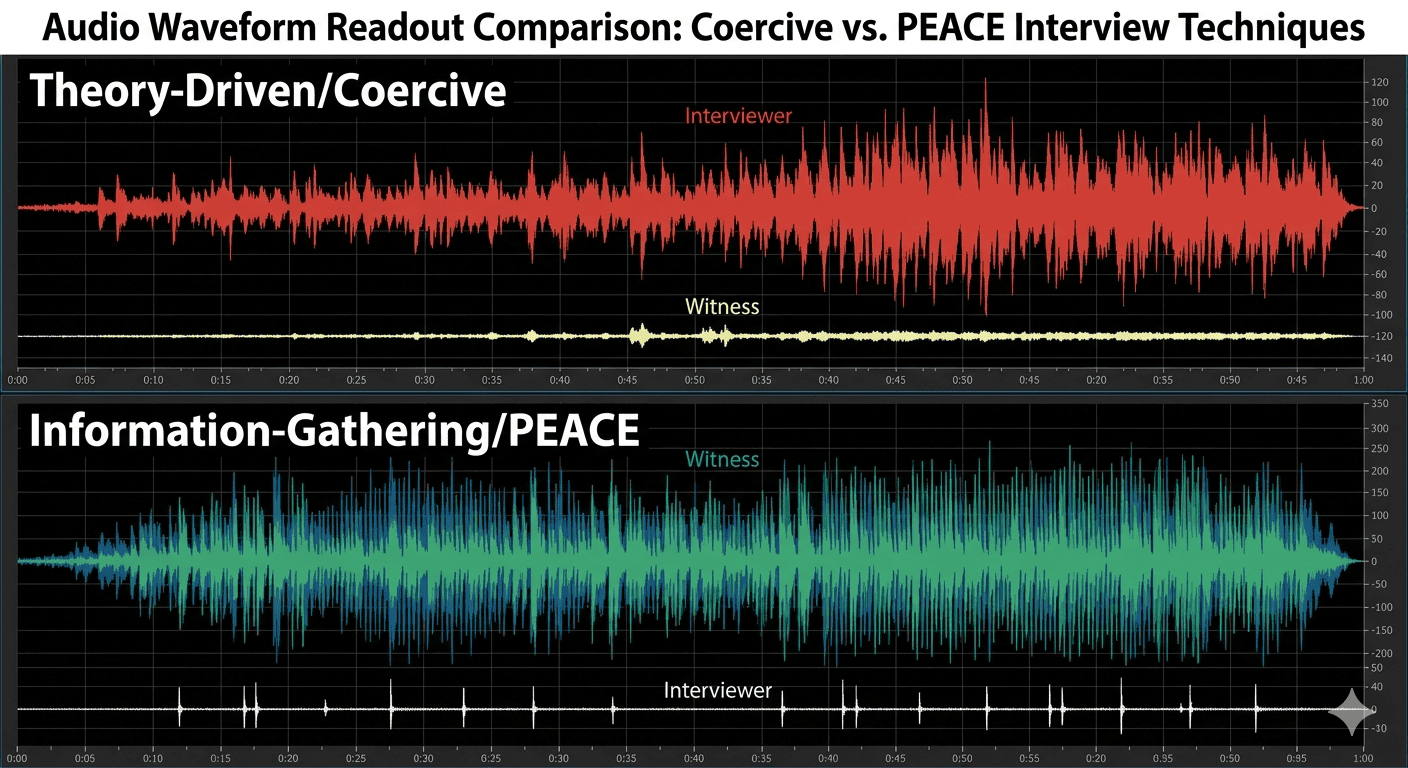
There is a blunt way to audit all of this: the talking ratio. Reviewers of recorded interviews lean on a rough benchmark, sometimes called the 80/20 rule. In a good information-gathering interview the witness should be talking around 80% of the time and the interviewer only 20%; confession-driven interrogations invert it, with the questioner filling most of the air with theories and pressure [10]. If you are talking more than the witness, you have stopped eliciting an account and started writing one. The job is not to look clever by talking. It is to look clever by listening.
6. Sequencing the funnel
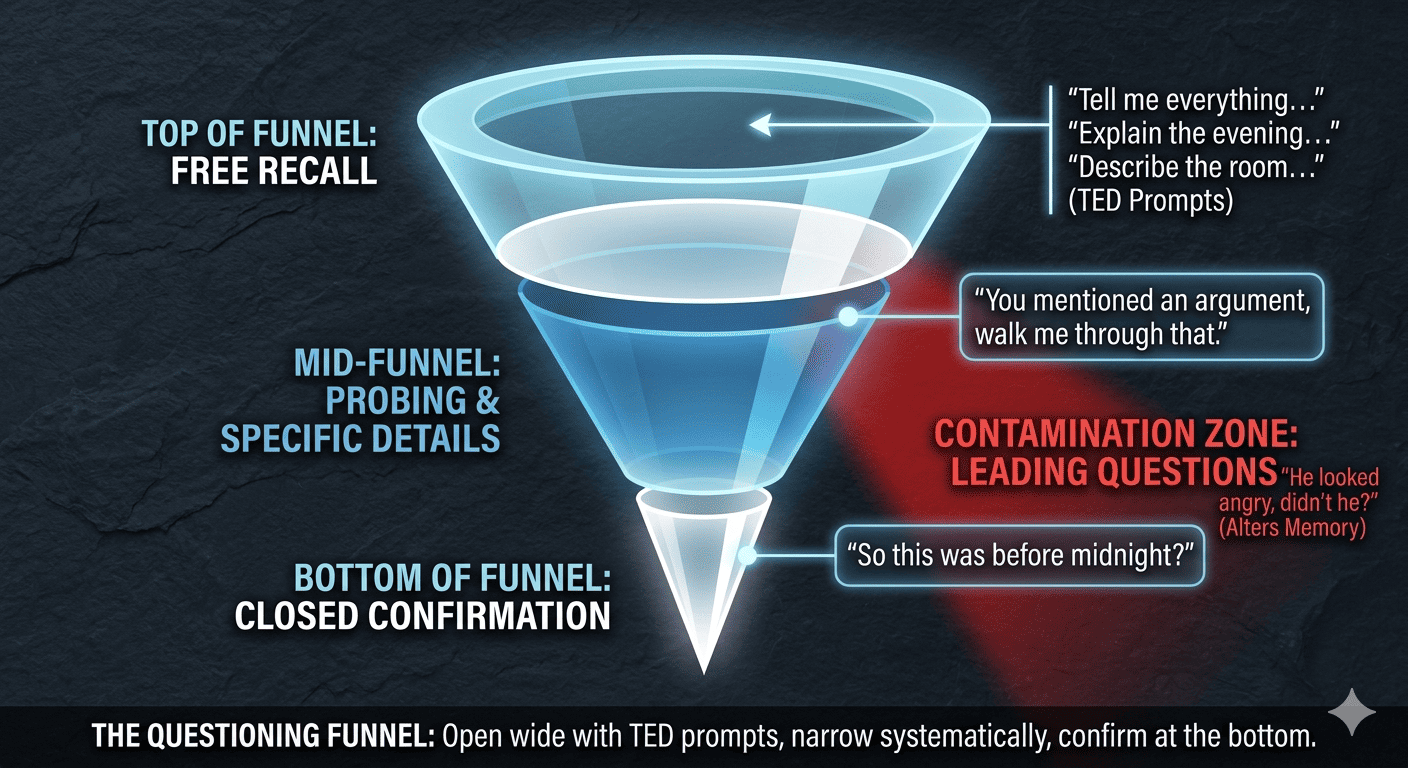
Put the pieces together and questioning has a shape: a funnel. You open wide, then narrow in stages, and you only ever reach for a closed question at the very bottom, to confirm a specific point the witness has already raised. Research on question typologies recognises an ordered family, broadly open, probing, specific-but-not-leading, and closed, with leading and suggestive questions sitting outside it as things to avoid [4][3]. Interviews fail when that order is inverted: studies of poor practice repeatedly find interviews dominated by closed, direct, and leading questions, with open questions used rarely or too late [4].
The funnel in practice looks like this. Open: "Tell me everything about the night." Probe: "You mentioned an argument, walk me through that." Specific: "Where exactly were you standing when it started?" Closed, only to confirm: "So this was before midnight?" Each stage builds on detail the witness has already volunteered, which means you are testing their account, not seeding it. Crucially, you re-open the funnel for every new topic. A witness might be on their third closed confirmation about the bar, and you still start the kitchen with "Tell me what happened in the kitchen." Closed-first is how interviews get short, thin, and wrong.
A few worked examples make the difference concrete:
| Bad question | Why it fails | Better question |
|---|---|---|
| "He looked angry, didn't he?" | Leading; supplies the conclusion | "How would you describe his mood?" |
| "Was he wearing a red coat?" | Supplies the detail | "What was he wearing?" |
| "Where was he and what did he say?" | Stacked; two questions, one thin answer | "Where was he?" then "What did he say?" |
| "Did she leave at 10?" | Closed too early | "Walk me through when she left." |
| "You didn't see anyone else?" | Negative; nudges toward "no" | "Who else did you see?" |
7. Make contradictions surface
Good questioning fills the account with detail. The payoff is what that detail lets you do next: catch contradictions. You rarely need to know a witness is lying. You need only notice that two accounts cannot both be true, or that one account collides with a fact you already hold.
This is the logic of the Strategic Use of Evidence (SUE) technique, developed by Granhag, Hartwig, and colleagues. The interviewer plans which facts to hold back, asks open and probing questions that circle the held-back evidence without revealing it, and discloses only late and strategically. A witness who does not know what you know commits to a version that then collides with the withheld fact, and that statement-evidence contradiction is the signal, independent of anyone's demeanour [7]. The same applies across people. If one witness puts a suspect at the bar all night and another saw him on the stairs, you do not have to know which is mistaken. The building cannot contain both claims, and the conflict itself is the evidence [8].
So the questioning sequence has a quiet strategic layer underneath the funnel. Open the account fully, before you reveal what you can check. Note where it must be tested. Disclose your evidence last, one piece at a time, and watch where the story has to bend to survive.
8. Working a rehearsed cover
One kind of account resists everything above: the rehearsed cover. A loyal witness protecting someone has often prepared a single clean line about one specific fact ("he never left the table"). Pushed head-on, that line holds, because it is the one thing they rehearsed, and they deliver it with the smooth confidence we misread as honesty [8].
The crack is adjacency. A rehearsed story is a wall, not a house: solid where you expect to hit it, with nothing built behind it. So you do not attack the protected fact. You question the detail around it that the witness never thought to prepare. Not "are you sure he stayed at the table?" but "what was he drinking, who refilled it, what were they talking about?" The protected claim stays rigid while the surrounding detail wobbles, contradicts the cover, or evaporates. This is just the verbal-content principle aimed at a structural weakness, and it is the through-line connecting questioning to lie detection: you beat a rehearsed account not by sensing the lie, but by out-asking the rehearsal.
There is a deeper tell hiding in the same place. When people invent an account they lean on a schema, a generic mental script of how a setting is supposed to go: you arrive at the restaurant, you order, you eat, you pay, you leave [12]. Scripts are smooth and predictable, and that is precisely the problem. Real memories are studded with script-deviant details, the small anomalies a script would never generate: the waiter dropped a fork, the card reader died, the kitchen had run out of the fish. So a rehearsed cover often betrays itself not through contradiction but through an eerie absence of mess. When an account is perfectly script-consistent, every beat landing exactly where a stranger would predict, you are probably hearing a schema rather than a memory. Ask for the anomalies outright: what went wrong, what was unusual, what do you remember that you would not have expected? A genuine account can nearly always produce one. A script cannot [8].
9. The questioning loop for a mystery game
Strip everything down and a single loop remains, the one a good detective runs on every witness, and the exact loop an interrogation game is built around:
- Open. Ask a wide question and let the account spill.
- Clarify and listen. Real accounts are messy, with tangents, self-corrections, and admitted gaps. Mark where an account is suspiciously smooth.
- Follow up on the edge. Probe the detail around the key claim, not the claim itself.
- Compare. Hold each account against the others and against what you already know.
- Flag the contradiction. When two things cannot both be true, that gap is your evidence.
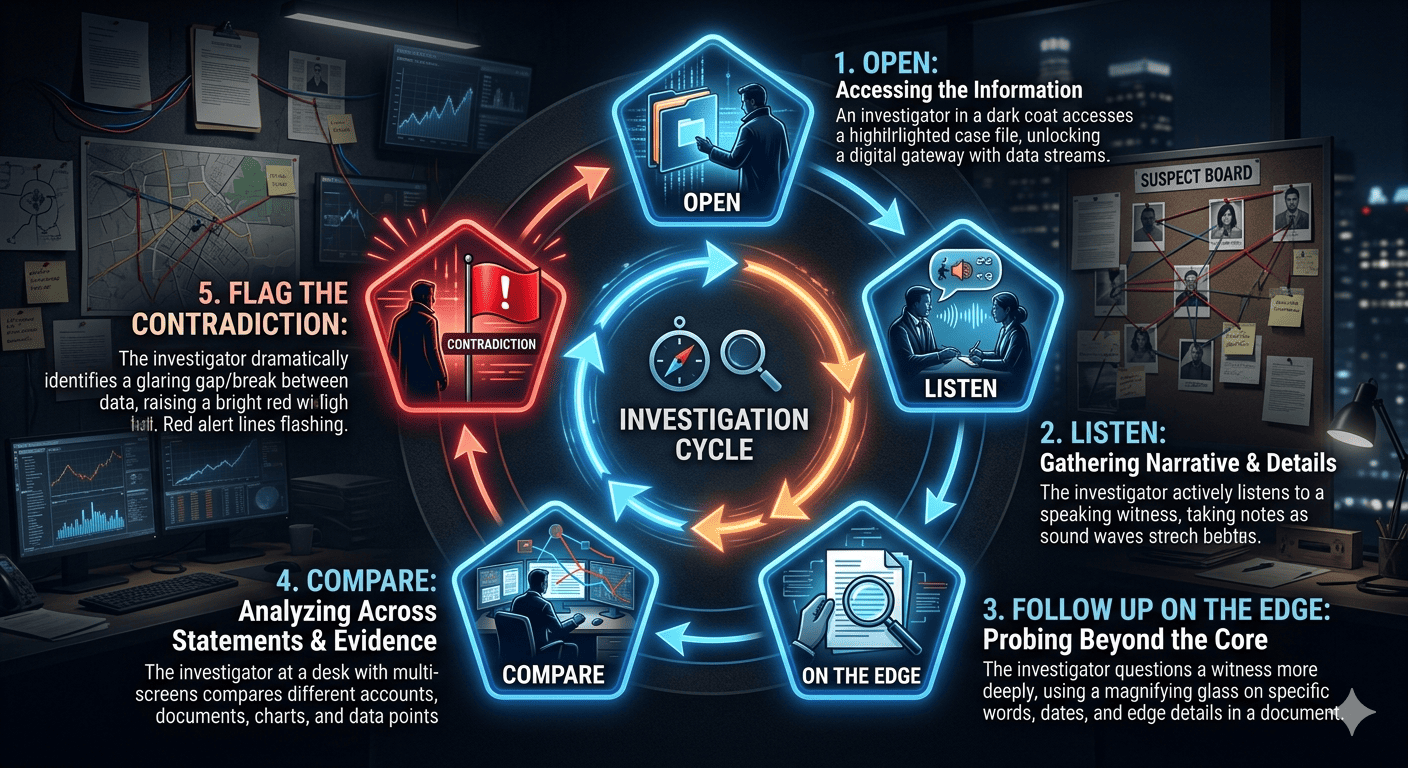
This is exactly what Third Suspect asks you to do. Each case gives you witnesses with loyalties and rehearsed cover stories, a limited question budget that forces you to ask well, and a flag system that rewards catching the contradiction between two accounts rather than guessing a guilty face. It is a low-stakes place to practise the loop until it is second nature.
10. What NOT to do
A handful of habits quietly wreck interviews:
- Don't lead. Any detail you put in the question can come back as the witness's "memory." [2]
- Don't stack questions. Ask one thing, wait, ask the next. Multiple questions get one thin answer. [5]
- Don't interrupt. Every interruption trains the witness to give you less and to follow your agenda instead of their memory.
- Don't out-talk the witness. If you are speaking more than they are, you are seeding, not eliciting.
- Don't fish for your theory. Going in determined to confirm a hunch turns questioning into a search for agreement, the same dynamic that drives false confessions. [9]
11. From the interview room to the case file
The craft of questioning is smaller than it looks. Open the account before you narrow it. Never feed the answer into the question. Follow up on the edges without contaminating the middle. Then compare accounts and let the contradictions do the work that no amount of staring at a face ever could. These are learnable moves, used by the best interviewers, lawyers, and journalists, and they are exactly the moves that turn a pile of witness statements into a solved case.
They also happen to be a game. If you want to practise open-then-narrow questioning, adjacency probes, and cross-witness comparison on cases built specifically to reward them, that is what Third Suspect is for. And if you have not read its companion, How to Spot a Lie in an Interrogation covers why the words, not the face, are where the truth lives.
A note on sourcing
Every figure in this piece is tied to a named study. The headline numbers, the verb-and-speed effect [2], the Cognitive Interview's roughly one-third gain in correct information [1][3], and the question-type findings [4][5][6], come from the primary papers and a meta-analysis. Where the evidence is a body of work rather than a single result, the citation points to the standard review.
Join the discussion