Almost everything the movies taught you about catching a liar is wrong. The shifty eyes, the fidget, the bead of sweat, the "micro-expression" that supposedly leaks the truth in a forty-millisecond flicker: decades of careful research say these signals are, at best, noise. The uncomfortable finding isn't that lie detection is hard. It's that the method most people use makes them barely better than a coin flip, and that the people most confident they can read a liar are often the worst at it.
This guide is the opposite of a listicle. There is no "5 surprising signs someone is lying," because the science does not support a list like that. Instead, here is what the research actually shows about deception, and, because we make an interrogation game, how those findings translate into a skill you can practise on purpose.
This is a research guide for interviews, games, and critical thinking, not legal or police-interrogation advice.
Key takeaways
Want to practise this as a game? Third Suspect turns these ideas into short witness-interrogation cases, each one a loyal witness, a rehearsed cover story, and a contradiction waiting to be caught.
1. The 54% problem
Start with the single most replicated number in the field. In 2006, Charles Bond and Bella DePaulo pooled 206 studies covering 24,483 people who tried to tell truths from lies with no special aids or training. The average accuracy was 54% [1]. A coin flip is 50%. Four points of edge, across a half-century of experiments, is the entire human advantage at spotting deception on the spot.
It gets more humbling. That 54% hides a lopsided pattern: people correctly flagged only 47% of lies as lies, while correctly clearing 61% of truths [1]. In other words, we are slightly worse than chance at catching an actual liar, and we make up the difference by believing honest people. Fewer than one judge in seven beats 60% accuracy [1]. And training the pros barely moves the needle. Timothy Levine's review of deception experiments going back to 1941 finds that teaching people to watch for behavioural "tells" typically lifts accuracy only to about 58% [4].
Surely seasoned investigators do better? Largely, no. When Garrido and colleagues tested experienced police officers on credibility judgments, their accuracy hovered near chance, and their confidence ran well ahead of their performance [11]. Experience tends to buy certainty, not accuracy. That gap, high confidence riding on low skill, is the through-line of this entire article.
Nor is this only a lab curiosity. When the U.S. Government Accountability Office audited the Transportation Security Administration's behaviour-detection program (officers trained to flag deceptive or suspicious travellers by their demeanour at airport checkpoints), it concluded the behavioural indicators performed no better than chance, and recommended that Congress stop funding them [12]. A deception-spotting program built on the very premise this article is about to take apart, deployed at national scale and at vast expense, could not beat a coin flip either.
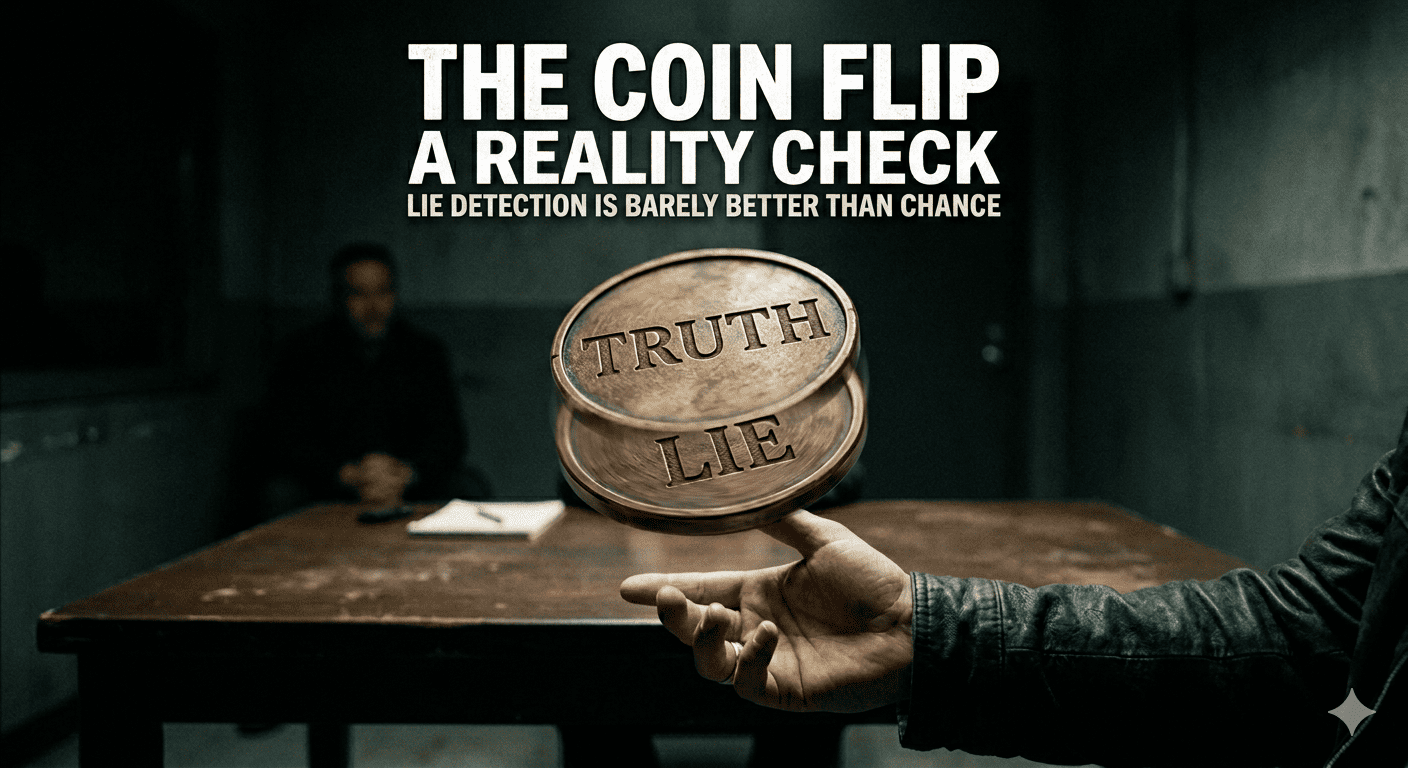
54%. Across 206 studies and 24,483 people, that is how often a human correctly tells a truth from a lie in real time. [1]
2. Why "tells" don't work
If you cannot watch a face and read deception, it is worth understanding why the intuition is so wrong.
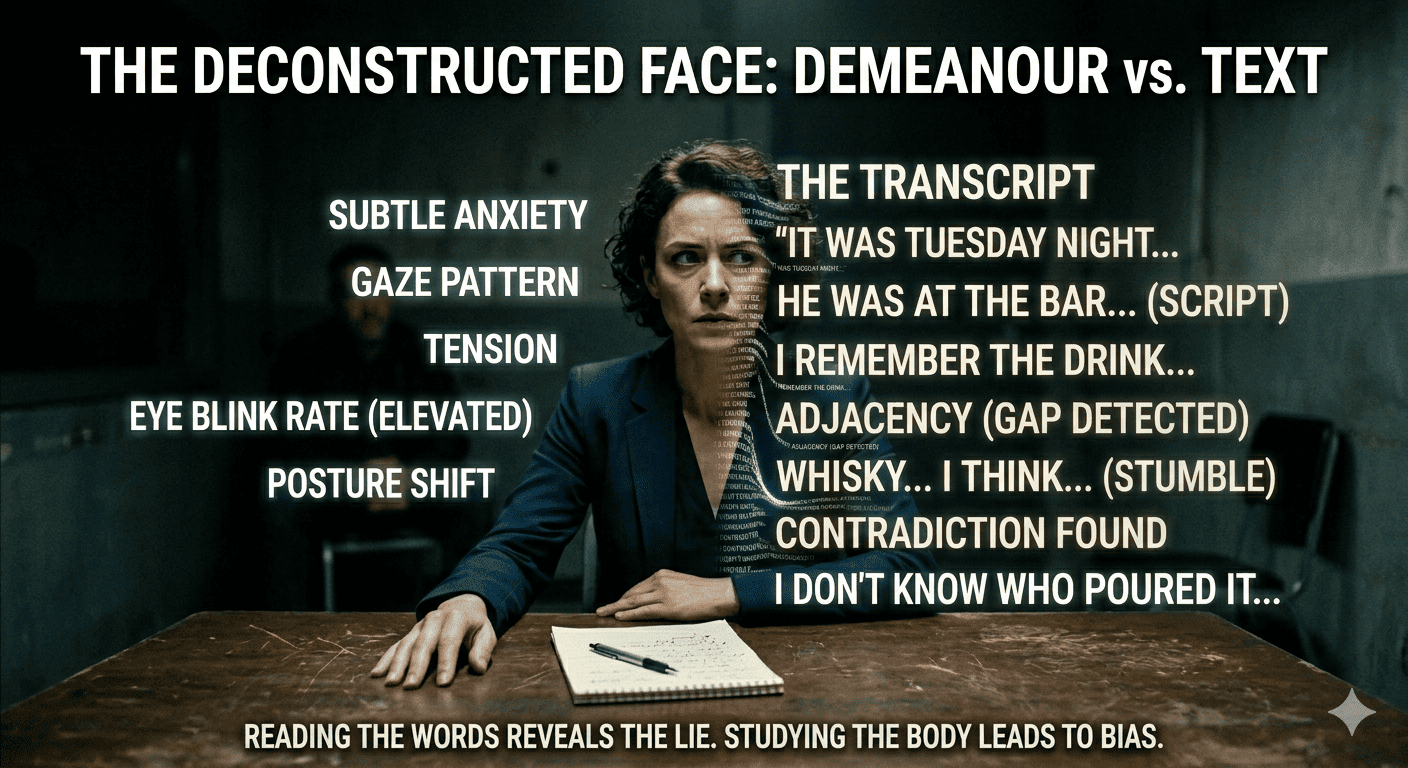
The definitive answer is DePaulo's 2003 meta-analysis, "Cues to Deception," which combined 1,338 estimates of 158 distinct behaviours thought to betray a liar [2]. The headline: most of them don't. "Many behaviors showed no discernible links, or only weak links, to deceit" [2]. As Vrij, Granhag, and Porter put it in their landmark 2010 review for Psychological Science in the Public Interest, there is no single dead-giveaway behaviour, no Pinocchio's nose that reliably lengthens when a person lies [6]. Take gaze aversion, the number-one folk belief about lying in virtually every culture studied: it is essentially useless. Liars do not avoid eye contact more than truth-tellers, partly because everyone "knows" they're supposed to, so they overcorrect [3]. Fidgeting, posture shifts, and grooming gestures fare no better. The whole folk catalogue of "tells" (touching your nose, breaking eye contact, shifting in the chair) has no reliable basis in the data.
And the most cinematic tell of all, the micro-expression, does not survive contact with the field either. The concept (a fleeting, involuntary flash of true feeling, popularised by Paul Ekman's research and dramatised in the TV series Lie to Me) has genuine laboratory roots, but the leap from a controlled experiment to a real interrogation is exactly where it breaks. Genuine micro-expressions are rare and easily missed in real time. The emotions they're supposed to reveal, fear and guilt, are not unique to liars; an innocent person under suspicion feels them too (the Othello error, below). And there is no good evidence that spotting them lets ordinary observers reliably separate truths from lies under field conditions [2][3]. It makes superb television and poor evidence. The point isn't that one magic signal is hiding among the 158. It's that the whole channel of body language is the wrong place to look.
The deeper trap is what Aldert Vrij calls the Othello error [3]: an honest person under suspicion is anxious because they are under suspicion, and that anxiety looks identical to a guilty person's. So when you "feel" someone is nervous and conclude they're lying, you may simply be watching an innocent person who is frightened of not being believed. Meanwhile, the practised liar, who expects scrutiny, actively suppresses the very cues you're hunting for [3].
This is also why the polygraph is not the truth machine of legend. The common "control question" polygraph rests on a "concern" assumption: that a guilty suspect will react more strongly to direct crime questions than to vague questions about past misdeeds [3]. But an innocent person accused of a serious crime is, reasonably, terrified of the direct questions too. Their freedom is on the line. That fear produces false positives at unacceptable rates [3]. The U.S. National Research Council's exhaustive 2003 review reached the same verdict: the science does not support the polygraph's accuracy for distinguishing lies from truth, especially in screening [7].
One more clue from the data points the way forward. Bond and DePaulo found people are reliably more accurate at judging audible lies than visible ones [1]. We do better with our eyes closed and our ears open. The signal was never in the body language. It was in the words.
| The myth | What the research says | What to do instead |
|---|---|---|
| Liars avoid eye contact | Gaze aversion is essentially useless; liars don't avoid eye contact more than truth-tellers [3] | Ignore the eyes; weigh the words |
| Fidgeting gives them away | Posture shifts and grooming gestures have no reliable link to deception [2] | Probe the detail of the account, not the body |
| Micro-expressions leak guilt | Rare, easily missed, and the emotions aren't unique to liars in the field [2][3] | Judge content over demeanour |
| The polygraph detects lies | The 2003 NRC review found the science doesn't support its accuracy [7] | Treat a "fail" as anxiety, not proof |
| Confidence signals honesty | Confident witnesses aren't more truthful; confident pros aren't more accurate [1][11] | Discount confidence, theirs and yours |
3. The paradigm shift: make lying hard
If passively reading a suspect fails, what works? The most important advance of the last two decades reframes the whole problem. Instead of treating lie detection as observation, treat it as interaction, and design that interaction so lying becomes cognitively expensive.
The premise, developed extensively in Vrij's work, is simple: lying is harder mental work than telling the truth [3]. A truth-teller just retrieves what happened. A liar has to invent a plausible story, keep it consistent, monitor your reactions, and suppress the real memory, all at once. If you increase that load, the liar's performance degrades in ways you can actually see, while the truth-teller is largely unaffected.
Three load-increasing techniques have the most support [3]:
- Unexpected questions. Liars rehearse the obvious questions. Ask the un-rehearsed one instead: not "what did you order?" but "who paid, and how was the table laid out?" The truth-teller answers easily; the liar stalls.
- Reverse-order recall. Ask them to tell the story backwards, from end to beginning. Recounting a real memory in reverse is taxing but doable; doing it with a fabricated, linear script is far harder, and inconsistencies surface.
- Free recall first. Open with "tell me everything, in as much detail as you can," before you narrow in. A genuine account spills detail; a script stays thin.
The shift is from "catch the leak" to "apply the pressure and watch what cracks." None of that depends on a gift. It is a method, which is exactly why it can be taught.
4. What people say beats how they look
Once you're listening to content instead of watching the body, the question becomes: what does a truthful account actually contain that a fabricated one lacks?
The foundational idea is Reality Monitoring, from Marcia Johnson and Carol Raye in 1981 [8]. Memories of real, experienced events tend to carry rich perceptual and contextual detail (sights, sounds, smells, spatial layout, time anchors) because they were genuinely lived. Imagined or invented events lean instead on cognitive operations ("I would have…," "I must have…") and come out comparatively flat and abstract [8].
DePaulo's meta-analysis backs this empirically. Relative to truth-tellers, liars are "less forthcoming" and "tell less compelling tales"; their accounts contain "fewer ordinary imperfections and unusual contents" [2]. That last point is counter-intuitive and useful: real stories are messy. They include the irrelevant tangent, the self-correction ("no, wait, it was Tuesday"), the admitted gap ("I don't remember what he was wearing"). Liars, trying to sound credible, sand all of that off and produce something suspiciously smooth.
So the diagnostic questions are not "did they look away?" but "did the account have texture? Did they correct themselves? Did they admit not knowing something? Could they describe the periphery of the event, not just its center?" A truth-teller can almost always tell you about the edges. A liar usually only prepared the middle.
5. The bias-protected lie
Here is the kind of lie that ordinary advice never addresses, and the one our game is built around. It is not the lie of a guilty suspect protecting themselves. It is the lie of a loyal witness protecting someone else.
These cover stories behave differently from self-serving lies. They tend to be short, rehearsed, and emotionally committed. The person has decided, in advance, to hold one clean line about one specific thing ("he never left the bar all night"). On that line they are smooth and confident, precisely the demeanour we misread as honesty [1][3]. Pushing harder on the line itself usually fails; they've prepared for that.
The crack is adjacency. A rehearsed cover protects a narrow fact, not the things around it. So you don't attack the fact. You ask about whatever sits next to it that the person never thought to prepare. Not "are you sure he was at the bar?" but "what was he drinking? Who was he talking to? When did you last refill his glass?" The protected claim stays rigid while the surrounding detail wobbles, contradicts the cover, or evaporates, because the liar built a wall, not a house, and walls have nothing behind them [2][3]. This is the verbal-content principle from §4 aimed at a specific structural weakness: rehearsal is brittle off-axis.
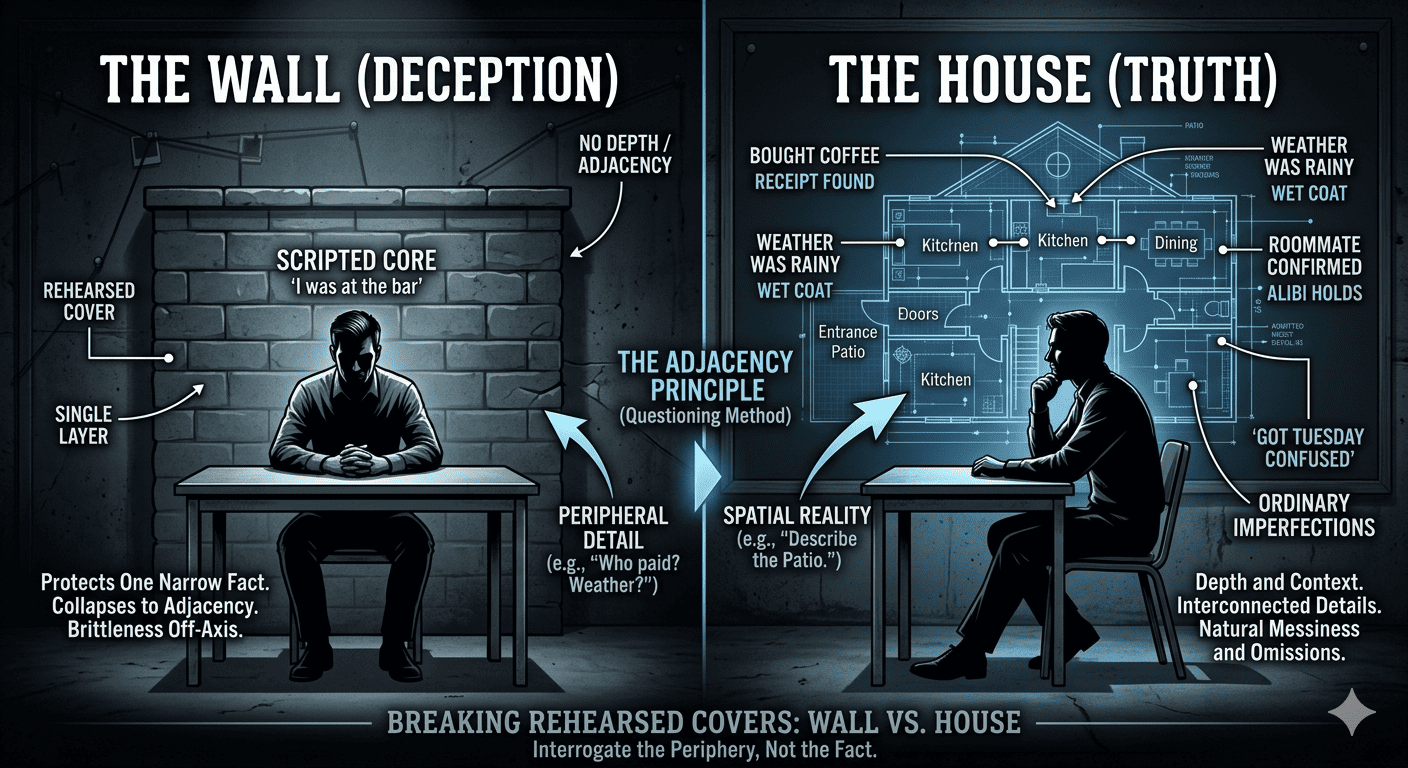
Picture it in miniature. You ask the loyal witness where the man was at eleven; "at the bar, never moved," comes back clean and fast. So you leave the bar alone and ask the edges. What was he drinking? A beat. "Whisky, I think." Who poured it? "I — I don't remember." The protected fact holds; the room around it dissolves. That stumble is not a nervous tic you're reading off a face. It is a gap in a script that was only ever written for one question.
This is also where Levine's work matters: people are not just bad at catching lies, they are wired to extend trust (more on that in §7), so a confident loyalist sails through on demeanour alone [4]. You beat the bias-protected lie not by sensing the loyalty, but by out-asking the rehearsal.
6. Two witnesses beat one
Now the most freeing idea in the whole field, because it removes the need to be a human polygraph at all.
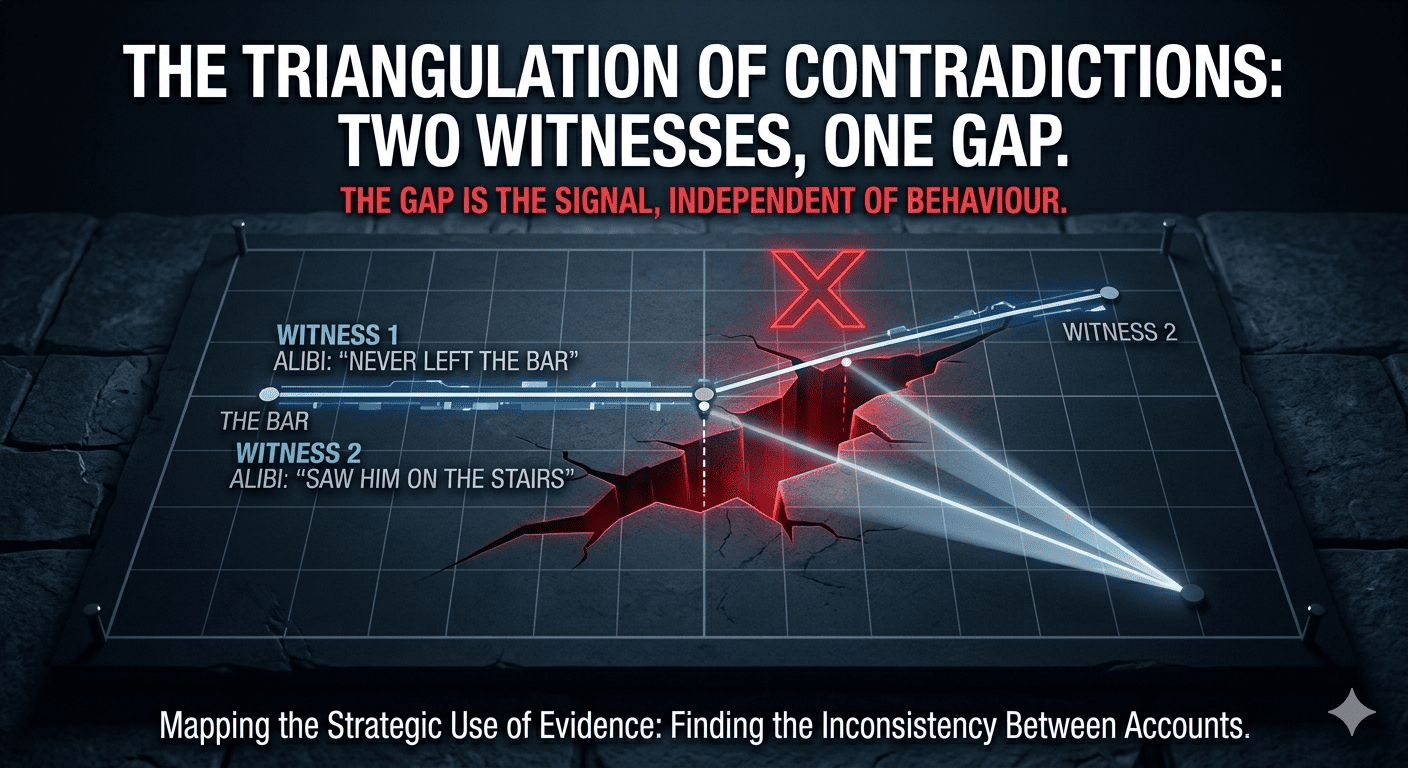
The Strategic Use of Evidence (SUE) technique, developed by Maria Hartwig, Pär Anders Granhag, and colleagues and laid out in a 2025 review they co-authored, starts from a structural insight: you often don't need to read this person at all. You need to find the inconsistency between what they say and what you already know [5]. SUE has three moves: plan which evidence to hold back, ask questions that probe that evidence without revealing it, then disclose it only strategically and incrementally [5]. A guilty suspect who doesn't know what you know commits to a version that then collides with the withheld facts, and that statement-evidence contradiction is the signal, independent of anyone's nervous tics [5]. The method is purpose-built to expose the two counter-strategies liars fall back on: avoidance (staying vague, omitting details) and escape or flat denial [5]. In controlled studies, interviewers trained this way improve their accuracy over those relying on demeanour [5].
The point is that you are never reading a face. You let a person commit to a story before they know which facts you can check, then compare the two and notice they cannot both be true.
This is why a second source is worth more than any "tell." If Witness A swears the suspect never left the room and Witness B mentions seeing him on the stairs, you do not have to know which one is mistaken or lying. You only have to notice that the building cannot contain both claims. The conflict is the evidence. Triangulating alibis across people is far more reliable than interrogating any single demeanour, and it is exactly what cross-examination, good journalism, and competent investigation have always quietly relied on [3][5].
7. Why we're bad at this in the first place
If contradictions are so powerful, why don't we catch more lies in daily life? Levine's Truth-Default Theory gives the answer: human communication only works because we default to believing each other [4]. We are biologically and socially wired to accept what we're told as true, and we only abandon that default when something forces us to: a glaring inconsistency, hard evidence, a confession [4]. The truth-bias in Bond and DePaulo's numbers (clearing 61% of truths while catching only 47% of lies) is this default, measured [1].
That default is not a bug; it's why society functions. Constant suspicion would make conversation impossible. But it means deception is the exception our minds aren't primed to catch in the moment. Which leads to Levine's most important practical point, echoed in Malcolm Gladwell's popular treatment of the same research: most lies are not caught live by a sharp-eyed observer. They are uncovered after the fact: through evidence, records, contradictions, and confessions, often days or years later [4][10]. The cinematic moment where the detective reads guilt off a twitching eyelid is, essentially, a myth.
"But I always know when my partner is lying." Maybe. But mind what that actually proves. In a close relationship you have what no interrogator does: deep base rates and a long shared history, so you catch the lie because the story clashes with something you already know, or because it surfaces later when the facts come out. That is the evidence-and-contradiction route, not real-time face-reading. And a quiet scorekeeping trick is at work: every time your suspicion lands you remember it, while the lies that sail past you, by definition, you never learn about. Personal certainty about "reading" people is built on a survivorship bias the laboratory strips away.
The takeaway is oddly liberating. You are not failing because you lack some gift other people have. You are leaning on a faculty, real-time demeanour reading, that does not exist in any usable form. Point your attention at evidence, contradiction, and the content of what people actually say, and the odds finally start to move in your favour.
8. Practical tips for an interrogation-style game
Synthesising all of the above into things you can actually do when you sit across from a witness, or boot up a case (for the full method, see the companion guide, How to Question a Witness):
- Open broad, then narrow. Start with free recall ("tell me everything") and let the account spill before you aim. Texture and self-correction are your truth signals [2][8].
- Ask the unrehearsed question. Skip the obvious; probe the periphery: who, where exactly, in what order, what the room looked like [3].
- Run it backwards. Reverse-order recall loads the liar and spares the truth-teller [3].
- Ask the same person twice. Come back to a topic later from a different angle; rehearsed lines stay identical while real memories vary naturally in wording [3].
- Work adjacency on cover stories. Don't fight the protected fact; interrogate the details around it until they contradict it (§5) [2][3].
- Compare across witnesses. Hunt for the contradiction between two accounts, not the tell within one. The gap is the evidence [5].
- Listen more than you watch. People judge audible lies better than visible ones; close the body-language channel and weigh the words [1].
9. What NOT to do
A few habits actively make you worse:
- Don't run a Reid-style "behaviour" read. The Behaviour Analysis Interview at the front of the Reid technique scores exactly the nonverbal cues §2 debunked, so it manufactures confirmation bias, coaching investigators to read ordinary stress as guilt and pushing innocent, anxious people toward the "deceptive" bin [3].
- Don't trust the polygraph as a verdict. Treat a "failed" test as an anxious person, not a proven liar [3][7].
- Don't ask leading questions. "He looked angry, didn't he?" contaminates the account with your theory; you'll get your own suspicion echoed back. This is the same dynamic that drives false confessions in the wrongful-conviction literature [9].
- Don't mistake confidence for accuracy, theirs or yours. Confident witnesses aren't more truthful, and confident interrogators aren't more accurate [1][11].
10. From the lab to the living room
The honest summary of the science is bracing: in real time, watching a person's face, you are a 54% lie detector, and no amount of staring will fix that [1]. But change your method and you move from passive observer to active investigator: load the conversation, mine the content for texture, work the edges of rehearsed cover stories, and above all compare accounts and let the contradictions surface. That is a learnable craft, and it is the one real interrogators, lawyers, and reporters actually use.
It also happens to be a game. Third Suspect is built on exactly these mechanics: witnesses with loyalties and rehearsed cover stories, an interrogation budget that forces you to choose your questions well, and a flag system that scores you for catching the contradiction between two accounts rather than for guessing a guilty face. It's a safe, low-stakes place to practise the skills above (broad-to-narrow questioning, adjacency probes, cross-witness triangulation) and to find out how good you really are once the eye-contact myth is off the table.
A note on sourcing
Every statistic in this piece is tied to a named study in the list below. The headline figures, the 54% accuracy rate [1], the 158-cue analysis [2], and the Strategic Use of Evidence method [5], come straight from the primary papers. A few supporting points are cited from established review summaries where the original was paywalled, and wherever the evidence is genuinely mixed we have said so rather than rounding it up.
Join the discussion